 SN Chemical Industries Ltd.
SN FloorTop® 100
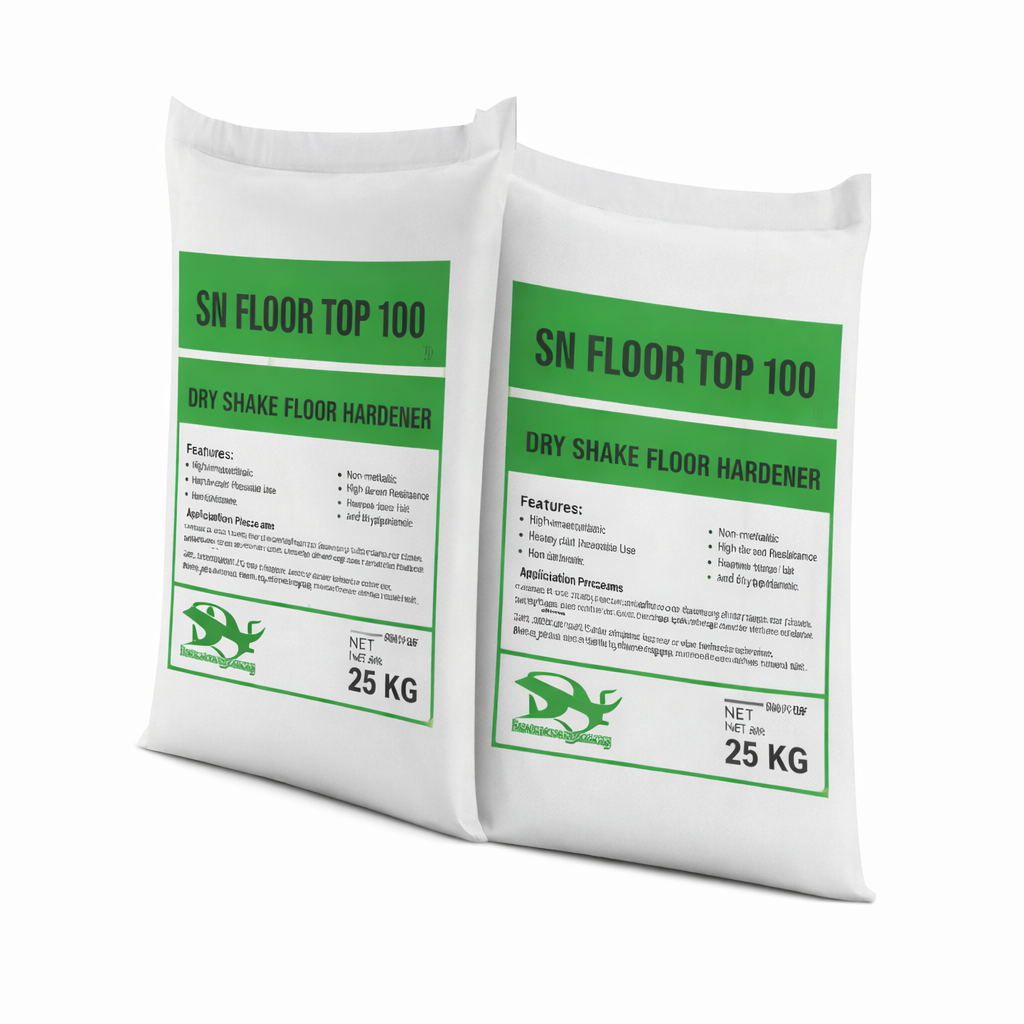
Premium pre-mixed dry shake floor hardener, applied to freshly placed concrete to enhance abrasion and impact resistance, improve slip resistance, deliver uniform colour/texture, and increase overall floor durability.
SN FloorTop® 100 — Full Technical Details
Description What it is
⌄
SN FloorTop® 100 is a premium pre-mixed floor hardener composed of high-quality clinker, selected mineral aggregates, performance admixtures, and engineered additives. It is applied as a dry shake onto freshly placed concrete to enhance abrasion/impact resistance, improve slip resistance, impart uniform colour and surface texture, and increase overall floor durability.
Typical Applications Where to use
⌄
- Aircraft hangars
- Basements and cellars
- Mechanical workshops
- Garages for light vehicles
- Storage rooms
- Corridors and halls
- Parking areas
- Loading platforms
Limitations Do not use
⌄
- Not for use where operating/service conditions require a metallic-aggregate hardener for higher abrasion/impact resistance.
- Not for use in areas exposed to acids and their salts or materials that rapidly attack/deteriorate Portland cement concrete.
Packaging 25 kg bag
⌄
SN FloorTop® 100 is packed in 25 kg moisture-resistant bags.
Typical Properties Key values
⌄
| Property | Value |
|---|---|
| Hardness (Aggregate) | 7 (Mohs scale of hardness) |
| Average rate of abrasion (Dorry Abrasion Machine) | 0.24 gms/min |
| Curing | Required |
Comparative Wear Test Results Dorry
⌄
Depth of Wear (Thickness Loss) — mm
| Sample reference | Control average | SN FloorTop 100 average |
|---|---|---|
| 5 minutes | 0.33 | 0.20 |
| 10 minutes | 0.61 | 0.30 |
| 15 minutes | 0.77 | 0.42 |
| 20 minutes | 0.95 | 0.50 |
| 25 minutes | 1.15 | 0.61 |
| 30 minutes | 1.34 | 0.71 |
| 35 minutes | 1.55 | 0.81 |
Weight Loss — gm
| Sample reference | Control | SN FloorTop 100 |
|---|---|---|
| 5 minutes | 2.87 | 2.4 |
| 10 minutes | 5.3 | 3.8 |
| 15 minutes | 7.5 | 5.0 |
| 20 minutes | 9.7 | 6.1 |
| 25 minutes | 11.9 | 7.3 |
| 30 minutes | 14.0 | 8.4 |
| 35 minutes | 16.1 | 9.7 |
Application Procedure Single-course monolithic floors
⌄
The Concrete (Minimum Requirements)
| Parameter | Requirement |
|---|---|
| Cement | Min 350 kg/m³ |
| W:C ratio | Max 0.50 (Min 0.40) |
| Slump | Ideally 75 mm |
| Strength | Min 31 N/mm² |
| Entrained air | Not exceeding 3% |
| Screed thickness | Min 75 mm |
Surface Preparation & Timing
- After placement, level with straightedge and compact by vibration.
- Float with a wooden float, keeping the surface open.
- Remove all bleed water — do not use sponge/absorbent materials.
- Broadcast lightly along bay edges (~80 mm wide) at construction/expansion joints and work in with a wooden float.
- Apply when surface moisture is optimal (neither too wet nor too dry). At 35–45°C, typical waiting time is ~30–40 minutes (longer at lower temperatures).
Dry-Shake Application (Two-Stage Method)
- Using a raised trestle system, broadcast ~two-thirds of the required material evenly by hand.
- Allow moisture absorption until the surface shows a uniform darkened appearance.
- Work into the surface using a wooden float or a power float fitted with float plates.
- Apply the remaining one-third once the first application has been worked in and the surface is ready.
- After absorption, refloat/power-float as needed to achieve uniform consolidation and finish.
- Final finishing may be carried out with blades when the concrete has hardened sufficiently (avoid burning the surface).
Application Rate Typical
⌄
Typical application rate ranges depending on service intensity and design requirements.
| Service / Use | Typical dosage |
|---|---|
| Light to medium duty floors | ~ 3–5 kg/m² |
| Medium to heavy duty floors | ~ 5–7 kg/m² |
Curing Required
⌄
Curing is essential. Cure the finished surface immediately after final finishing using a suitable curing method (curing compound or wet curing as per site practice) to minimize moisture loss and improve performance.
Protection Early-age care
⌄
- Protect the floor from rapid drying (wind/sun) during finishing and early curing.
- Avoid contamination during curing; restrict access until adequate strength is achieved.
- Prevent water ponding and premature heavy loading during early life.
Cleaning After use
⌄
Clean tools and equipment using water immediately after use (before material hardens).
Sawing Joints Jointing
⌄
Saw-cut contraction joints as per slab design and site plan. Timing depends on temperature and concrete set. Avoid damaging arrises; keep sawing consistent across the floor area.
Storage Keep dry
⌄
- Store in a dry, sheltered place in unopened original packaging.
- Protect from moisture; keep bags off the ground and covered.
- Use stock on a first-in/first-out basis.
Safety Precautions HSE
⌄
Quality & Care Good practice
⌄
- Ensure uniform application to avoid shade variation and weak zones.
- Do not overwork the surface or add water during finishing.
- Follow curing best practice to achieve full performance and minimize cracking/dusting.
- Final appearance depends on concrete quality, timing, finishing technique, and curing conditions.